Details
Duration:
5'
Instrumentation:
ob, vl, vla, vlc,
Written for:
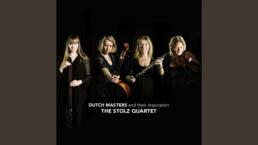
The Stolz Quartet
At first glance, it might seem an unlikely combination: Theo Verbey and Alexander Scriabin.
Verbey was a composer who thought in very clear structures, a lover of clear lines, and one who approached his musical material with detachment and liked to arrange it in predetermined numerical relationships.
Scriabin, the elated mystic, said he wanted to “possess the world as he possessed a woman,” someone with no less ambition than to “bring humanity to a higher level of consciousness” with his music. His music aspired to intoxication and ecstasy; he was a synesthete who saw colors in every harmony, someone who embraced the esoteric and the occult. Scriabin, a contemporary and classmate of Rachmaninov, started as a sensitive heir to Chopin and grew to become one of the most radical composers of the early twentieth century by developing a totally idiosyncratic harmonic language.
How can that be rhymed with Theo’s pursuit of a concise and extremely clear way of composing? One of the Scriabin preludes that Theo arranged literally has the word “vagamente” (vaguely) as its performance indication!
And yet, Scriabin is a composer who always fascinated Theo. In addition to this arrangement of the Préludes op. 33, for example, Theo quotes Scriabin’s Vers La Flamme in his 2006 Piano Concerto. In that piece, what immediately stands out is the way Scriabin’s harmonies are placed in a context reminiscent of Stravinsky. And perhaps that is the pivotal connection between the two: Scriabin undeniably influenced early Stravinsky. We know that Stravinsky immersed himself in Scriabin’s late piano sonatas while working on the Sacre, but later, as an anti-romanticist, Stravinsky vehemently denied that influence. Theo never made a secret of other composers’ influence on his work; in fact, he once admitted writing music influenced “to the saturation point” by others. He knew that such influences never undermined his unique individuality. Verbey must have been fascinated by Scriabin’s dizzying sense of harmonic colour.
What is striking in this arrangement is the emphasis on the linear, clear aspect of Scriabin’s piano Préludes, which reflects the scoring for three strings and oboe—the perfect balance between intoxication and the clear line.
by
Jeppe Moulijn, board member Theo Verbey Foundation
In Theo's Own Words
“In 1903, Alexander Scriabin composed four preludes for piano solo with the opus number 33. In 2011, Theo Verbey arranged these short piano pieces for hobo, violin, viola and cello. The first prelude of opus 33 has a hesitating character with a main melody in the oboe, and the strings playing the accompaniment. The second prelude has the designation vagamente and has an uncertain character. The third contrasts strongly with the previous two with an abrupt and insistent atmosphere. Scriabin added the indication con collera (= with anger). The fourth and last has the indications ardito, meaning boldly, and bellicoso, which means bellicose. The speed of this fourth prelude has been increased through the use of five beats in the measure.
The arrangement has been entirely based on the combination of the four instruments, incorporating all the characteristics that hobo, violin, viola and violoncello have individually. Every association with the piano as an instrument is gone, so that an almost entirely new piece is created.”
– Theo Verbey
In Concert
29 Mar 2015
Stolz Quartet/Verbey, Zuidam, de Vries, Lann, Carter, Yun, Stockhausen, Ligeti, Knussen, Sheperd
Amsterdam, Netherlands
28 Mar 2015
Stolz Quartet/Verbey, Zuidam, de Vries, Lann, Carter, Yun, Stockhausen, Ligeti, Knussen, Sheperd
Amsterdam, Netherlands
27 Mar 2015
Stolz Quartet/Verbey, Zuidam, de Vries, Lann, Carter, Yun, Stockhausen, Ligeti, Knussen, Sheperd
Amsterdam, Netherlands
26 Mar 2015
Stolz Quartet/Verbey, Zuidam, de Vries, Lann, Carter, Yun, Stockhausen, Ligeti, Knussen, Sheperd
Amsterdam, Netherlands